

As the Los Angeles fires raged on, a video on Instagram showed some men grabbing a TV from a home. The caption: “Fires and looting. A regular Democrat run city.”
Except that wasn’t true at all. An organization called Lead Stories, which is among the many independent bodies that Meta relies on for fact-checking, debunked the claim. They found that the men in the video were relatives who were trying to save the family’s belongings. Meta added a fact-check label.
Lead Stories’ slogan is “Just because it’s trending doesn’t mean it’s true”. That’s worth remembering at a time when many of the posts related to the fires are outright lies.
Unfortunately, this hasn’t been a great time for facts.
On Jan. 7, the same day that the L.A. fires started going out of control, Meta announced that it will cease its fact-checking program on Facebook, Threads and Instagram. Instead, the company said it will rely on user notes to correct inaccurate and false posts.
CEO Mark Zuckerberg said that while this will mean more “bad stuff” on the platforms, the “trade-off” is worth it to avoid “too much censorship”.
Meta will now follow the community notes model that Elon Musk has adopted, and will also move its “trust and safety and content moderation” operations from California to Texas. Why? “To do this work in places where there’s less concern about the bias of our teams,” Zuckerberg said.
The falsehoods on social media have long been about partisan politics, but now fact-checking itself is seen as a partisan issue.
As the New York Times has reported, Zuckerberg decided to make the changes after visiting Trump at Mar-a-Lago over Thanksgiving, a trip that was Zuckerberg’s idea.
While major updates to Meta’s governance policies usually take many months, and involve a large group of stakeholders, the Times said that Zuckerberg “turned this latest effort into a closely held six-week sprint, blindsiding even employees on his policy and integrity teams.”
It’s no surprise to see tech oligarchs fan the flames as they cozy up to the incoming U.S. administration. On a recent episode of her Pivot podcast, tech journalist Kara Swisher called Zuckerberg “a sad and shameless weather vane”, someone who is “bending the knee” and has “no values whatsoever”. After talking to many people inside Meta, Swisher reported that “They are sick to their stomach.”
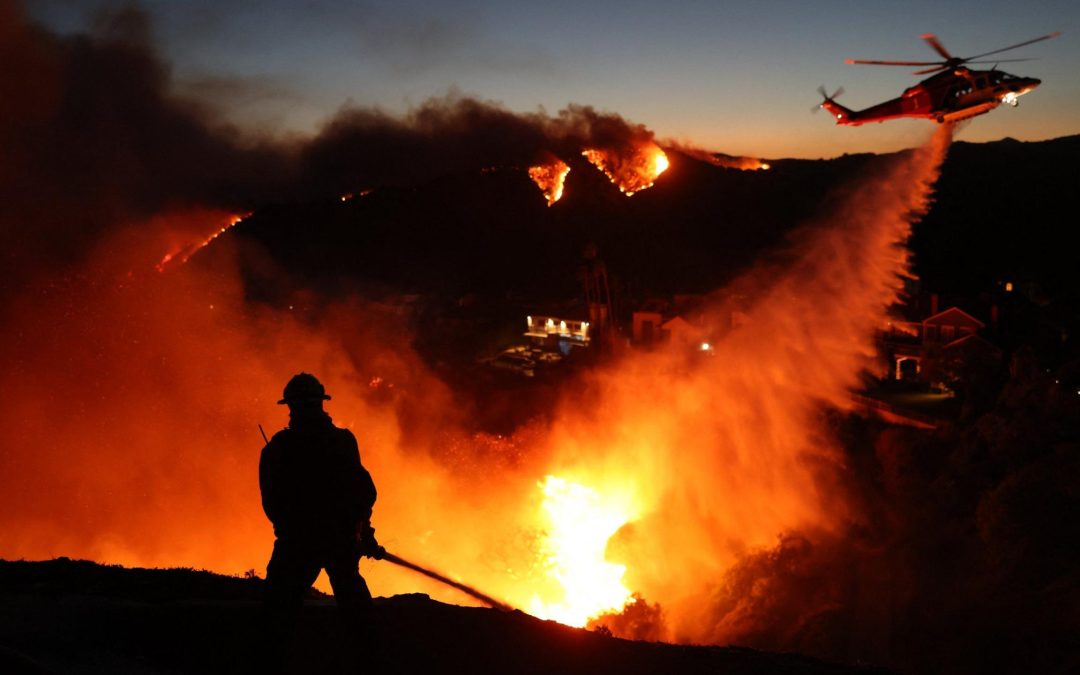
We require fact-checking more than ever. And if you still need to be reminded of that, just look at what’s happening around the current wildfires in the L.A. area.
Blaze of conspiracy theories
In light of the fires, an article on the CNN website noted what they called “a wild blaze of conspiracy theories” on social media.
For one, the tinfoil hat brigade is spreading posts (I’ll spare you the links) that assert the U.S. government is purposely setting the fires using military-grade direct energy weapons, in order to initiate a massive land grab. That one has been viewed a few hundred thousand times.
Other posts have claimed that the L.A. fire department was unprepared because they had sent most of their supplies to Ukraine, that this is all part of a conspiracy to accelerate 15-minute city plans for L.A., and that the fires were set to destroy evidence related to allegations of sexual abuse against Sean “Diddy” Combs.
Some posts are just troublemaking. PolitiFact exposed that an image on Instagram showing the Hollywood sign on fire was actually an AI creation. That post was subsequently flagged.
The organization Full Fact also looked into a video shared on Facebook, Instagram, Threads, X and YouTube that showed a supposed firefighting plane crashing in L.A. The video was actually from a crash in Chile a year ago.
Beyond the mischief, many posts are intentionally misleading for other purposes. Like the unfounded one on X claiming that the California governor is working with developers to rezone Pacific Palisades for mass apartments.
Meanwhile, Musk is a prime offender, not only enabling but also personally spreading misinformation. He went on X to denounce diversity, equity and inclusion policies as a root cause of the fires: “DEI means people will DIE.”
Is this really the time to curb the watchdogs?
“Cutting fact-checkers from social platforms,” says Alan Duke, co-founder of Lead Stories, “is like disbanding your fire department.”
Do warning labels work?
Even with fact-checkers, it’s an uphill battle.
A study published in 2022 in Information Systems Frontiers noted that while fake news isn’t a new phenomenon, social media’s features such as retweeting and sharing mean “misinformation can propagate like wildfire”.
Still, the researchers’ analytical models identified that the “truthfulness rating” was a significant factor in what gets spread: conclusive fact-checks (whether deeming something as true or false) get shared more.
Other research by the MIT Sloan School of Management found that fact-checker warning labels on social media work. They can lower beliefs in and spread of misinformation overall, even among people who have doubts about the fact-checkers themselves. Those who lean right politically are more likely to see and share misinformation and less likely to trust fact-checking, but warning labels still have a beneficial impact, the research found.
In its statementabout their policy changes, Meta said “Experts, like everyone else, have their own biases and perspectives. This showed up in the choices some made about what to fact-check and how. Over time we ended up with too much content being fact-checked that people would understand to be legitimate political speech and debate. Our system then attached real consequences in the form of intrusive labels and reduced distribution. A program intended to inform too often became a tool to censor.”
That’s not the case according to several of the organizations that have partnered with Meta on third-party fact-checking, who spoke out in an article that appeared after the Jan. 7 announcement.
“Fact-checking journalism has never censored or removed posts; it’s added information and context to controversial claims, and it’s debunked hoax content and conspiracy theories,” said Angie Holan, director of the International Fact-Checking Network. “To my knowledge they [Meta] didn’t take anything down just because it was false. Their takedowns were only with false information that could cause harm.”
“Our work isn’t about censorship,” added Lori Robertson, director of the nonpartisan website FactCheck.org. “We provide accurate information to help social media users as they navigate their news feeds. We did not, and could not, remove content. Any decisions to do that were Meta’s.”
Will crowdsourcing the job eliminate bias and help to clean up the cesspool? Maarten Schenk, co-founder of Lead Stories, is unconvinced.
“In our experience and that of others, community notes on X are often slow to appear, sometimes downright inaccurate and unlikely to appear on controversial posts because of an inability to reach agreement or consensus among users,” Schenk said. “Ultimately, the truth doesn’t care about consensus or agreement: the shape of the Earth stays the same even if social media users can’t agree on it.”
Social media platforms play with fire
Maybe using fact-checkers to counter falsehoods on social media is as effective as using a cup of water to extinguish an inferno. It’s hard to compete with the bots, trolls and algorithms.
I still use X, Threads and Instagram daily (though X less than before), and do find value. But let’s face it, the looming absence of fact-checkers isn’t a bug but a feature, part of the business model.
Renee Hobbs, an expert on media literacy education and director of the University of Rhode Island’s Media Education Lab, recently talked about how propaganda and disinformation have become “a growth industry” with the rise of state actors as well as “homegrown conflict entrepreneurs”. Stirring up anger and hate on social media, regardless of the facts, “is now a game played for fun and profit”.
Sure, you can delete the apps if you want. But that doesn’t solve the larger problem. And it doesn’t help when the people in charge of our biggest social media platforms are themselves arsonists who use truth as kindling.
Musk is busy acting out his Bond movie villain fantasies as the shadow president. (He and Trump almost share a name: Elon and Felon.) And Zuckerberg has Meta preemptively sucking up to MAGA. When asked whether Meta’s policy shifts on content moderation was motivated by his threats against Zuckerberg, Trump replied “Probably, yeah.”
The people who run these sites play with fire, and we all get burned.
As the X owner elongates his perverse conspiracy theories, and Meta’s founder claims to be returning his company to its “roots around free expression” (yeah, right), one thing is clear. When it comes to facts, we’re all royally Musked and Zucked now.
Stuart Foxman is a Toronto-based freelance writer, who helps clients’ products, services, ideas and organizations to come alive. Connect with me here on LinkedIn, or check me out at foxmancommunications.com where I share these blogs too. More original posts coming regularly about communications, information, motivation, writing, branding, creativity, media, marketing, persuasion, messages, learning, etc.
January 15, 2025