

You may never have heard of Susan Bennett, born in Burlington, Vermont in 1949. But you’re familiar with her alter ego.
Over her career, Bennett has done acting, singing and extensive commercial work. But you likely don’t know her from any roles, her ads for Coca-Cola and Visa, or her recorded public address system announcements for Delta Air Lines terminals. No, you know Bennett – or, more correctly, her voice – for the recordings she made almost 20 years ago, part of the development of an upstart product.
In the summer of 2005, Bennett got an assignment from a software company. She was hired to spend four hours a day recording a series of words and phrases. The idea was to compile a bank of them that, when combined, could transform into any string of sentences and paragraphs.
That’s how Bennett ended up being the original voice of a virtual personal assistant that launched as an app for iOS 15 years ago this month, in February 2010. Two months after that, Apple acquired the technology, which had emerged from a spin-off of the Stanford Research Institute.
Those SRI initials aren’t what gave the tech its name. Dag Kittlaus, co-founder of the venture, had a Norwegian colleague named Sigrid. He just liked the sound of the short form of her name: Siri.
Siri isn’t alone. Over time, we’ve made acquaintances with Amazon’s Alexa, IBM’s Watson, Samsung’s Bixby and Microsoft’s Cortana. And those are just the well-known AI-powered assistants. Niche assistants and chatbots cover all sorts of realms, like:
- Mya and Olivia (recruitment)
- Eve (legal)
- Albert (marketing)
- Charli, Emma, Aiden, Leo and Frank (finances)
- Sophie (style and fashion)
- Molly (physical health)
- Ellie and Tess (mental health)
- Otto (logistics)
- Hugo (workflow management)
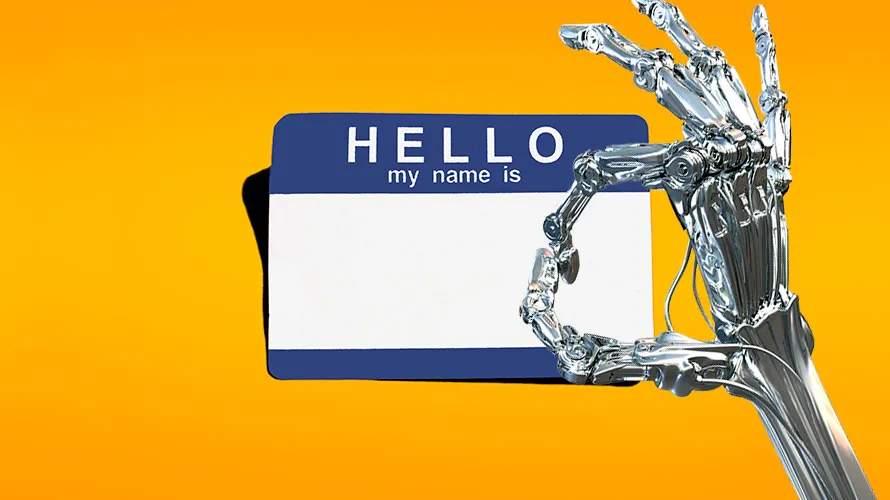
Why do so many of these products have human names?
Our first-name basis future
Naming companies and products after actual people isn’t new, but it’s usually the names of the founders. There’s a difference between eponymous brands and giving technology the sort of name you’d give your kid.
It tends to happen with just this one slice of the sector. Tech companies overall have names like Google and Meta, Zoom and Bing, Oracle and Slack, Yahoo and YouTube, DeepMind and Nuro. Names can veer to the futuristic, abstract, descriptive and whimsical. There’s no single naming formula. Except when it comes to virtual assistants, where we’re on a first-name basis.
People names used to be reserved for actual people. Or pets. You know, the living and breathing beings that are most precious to us.
Virtual assistants live with us too. The technology is part of our daily routines. But that’s true for many other appliances, and they don’t get a person name. I’ve never called my fridge Fred. What makes AI so special?
One, human names break down barriers.
Conversing is one of the most basic things people do, but doing so with a machine is wholly unnatural. Giving that machine a human name makes it feel more approachable and less threatening.
Hear names like Cyberdyne Systems, Skynet and the T-1000 in the Terminator movies, and you just know they want to harm humanity. But someone named Alexa? She wouldn’t hurt a fly. We know people named Alexa.
Two, we like to give social value to certain objects.
AI is a new, enigmatic and intimidating technology. Most people have no idea how it works, and don’t fully understand the extent of what it might do for (or to) us. It’s a bit of a mystery, yet we choose to talk to it casually.
Part of what’s happening here is anthropomorphism: the idea of attributing human characteristics or social value to inanimate or non-human objects.
That has occurred throughout history, from our mythologies around deities to Mickey Mouse to the playthings in Toy Story. Anthropomorphism can make an entity feel more relatable, especially one that’s so daunting and that seems to have the essence of what makes us human: a brain and language.
It’s no accident that AI seems friendly
The branding trend of giving AI human names has its detractors.
We rely on AI to carry out many mundane tasks and serve our immediate needs. As one critic pointed out in The New Statesman, it may be no coincidence that many AI names and voices are female – easier to “exploit without guilt”, she wrote.
Beyond the gender stereotyping, it could also be self-defeating to humanize this particular technology.
Today, many people have legitimate worries about being eliminated by AI. A report from Goldman Sachs suggested that while AI might drive an increase in global GDP and productivity growth, it could also put at risk a massive chunk of the workforce. As they phrase it in more clinical terms, “Shifts in workflows triggered by these advances could expose the equivalent of 300 million full-time jobs to automation.”
There is a bright side. “Jobs displaced by automation,” stated the report, “have historically been offset by the creation of new jobs.”
So it’ll be a hot market for, let’s see, machine learning engineers, cybersecurity specialists, data scientists, AI ethicists and maybe security guards for tech billionaires. But given the expected level of replacement, perhaps it’s not a great idea to assign a cuddly human name to the replacer.
All of this job disruption may turn out to be the better news. The bad news? Geoffrey Hinton, known as the godfather of AI, has speculated there’s at least a 10% chance that AI can trigger some sort of calamity that could lead to human extinction by mid-century.
I’m not anti-AI. I’d just like to see different sorts of names for it, that get at its function.
If you want something in your life that sounds friendly but secretly has it in for you, we already have a name for that. It’s called friends and family.
And if we as creators have an urge to give something a human name, I suggest we confine it to our children. Although there are plenty of AI tools now that can take over that job too. All sorts of sites for moms-and-dads-to-be now promote baby name generators that can provide personalized and voluminous suggestions – all, they say, without the biases of the parents.
I realize that AI can free up our time, but some things are better left in the hands of humans. We can name the robots; they can’t name us.
Stuart Foxman is a Toronto-based freelance writer, who helps clients’ products, services, ideas and organizations to come alive. Connect with me here on LinkedIn, or check me out at foxmancommunications.com where I share these blogs too. More original posts coming regularly about communications, information, motivation, writing, branding, creativity, media, marketing, persuasion, messages, learning, etc.
February 26, 2025