

A British land agent who was born in 1832 in Norfolk, England has been all over the news lately. Well, not him exactly, but the thing he’s best known for: the meaning of his name.
Let’s call him Mr. B. After failing an exam at a military academy, his family bought him a commission. He later became a land agent in Ireland, managing 1,500 acres in County Mayo for a wealthy landowner. In 1880, after a time of bad harvests, the Irish National Land League asked Mr. B to lower rents. Instead, he served writs of eviction.
The Land League encouraged Mr. B’s employees to strike, and urged the community to isolate him. Everyone from the blacksmith to local shopkeepers stopped serving him. Soon, he was forced to leave for England. His name? Charles Boycott.
The present-day Mayo County Council, on their website, still describe Charles Boycott with words like “cruel”, “tyranny” and “extortionate”.
You may not be familiar with his story, but we all know the word boycott. I think we also know of cruel tyrants who practice extortion.
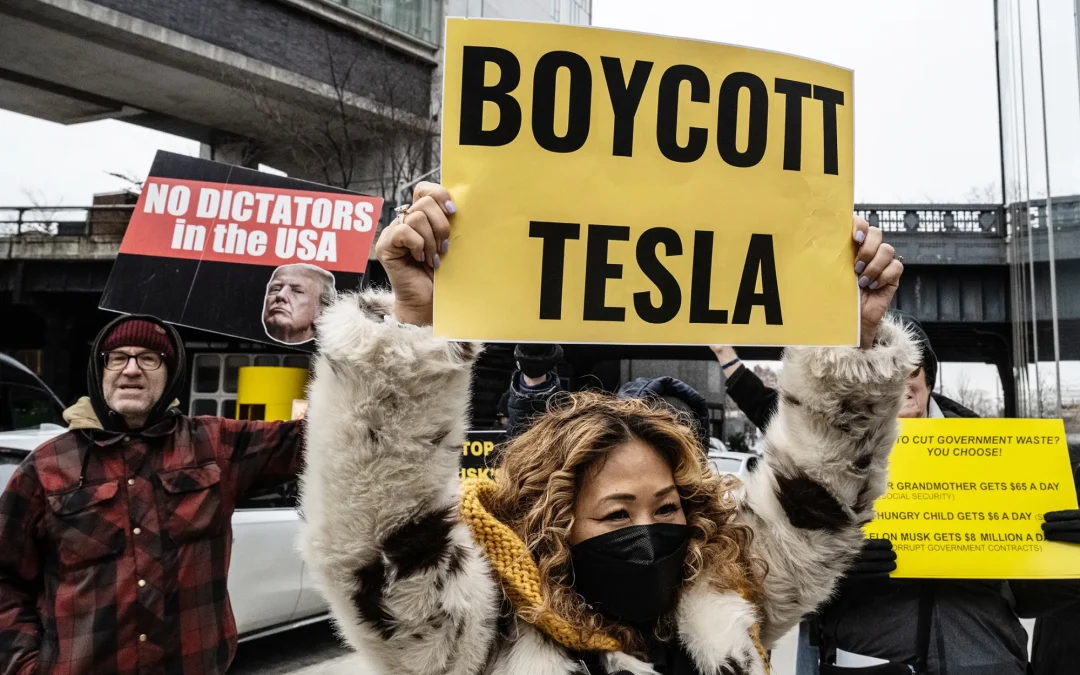
Boycotts are in the news.
- On this side of the border, in the wake of tariff wars and 51st state threats, many consumers and businesses have been looking to buy Canadian and boycott U.S. products.
- Meanwhile, in the U.S., groups of activists have called for boycotts of companiesthat have abandoned DEI initiatives.
- Charlie Angus, an NDP MP, recently advocated for a national boycott of Amazonin light of the company’s labour dispute with Quebec workers and its closures of facilities in the province.
- And searches for “boycott Tesla” have spiked on Google while Tesla’s sales and stocks have seen dips, as Elon Musk continues to embrace the far right and play a primary role in dismantling the U.S. government.
So Charles Boycott endures as an eponym. That’s the term used to describe a noun formed after a person.
Some eponyms are brands that have become so synonymous with a product category that they’re used generically. For instance, a Jacuzzi isn’t just a hot tub. It’s the last name of seven Italian brothers who started a machining company after they immigrated to California in the early 1900s. And a Zamboni, the catch-all name we use for an ice resurfacing machine, was developed by Utah-born Frank Zamboni, formerly of the block ice business.
With other eponyms – like Alzheimer’s disease (neurologist Alois Alzheimer), pasteurization (chemist and microbiologist Louis Pasteur), or Victoria, B.C. (Queen Victoria) – we tend to know that a real individual gave the thing its name.
Then there’s eponyms (like boycott) that are so familiar that it’s surprising to learn there was an actual person behind them. In fact, the word sounds strange as a person’s surname rather than as a noun.
Here are eight more. I’ll leave the name of the person until the end of each description. The headers provide clues too. See if you can figure out the word they provided to the world.
The perfect fit
Mr. L, born in Toulouse, France in 1838, was headed for a career in law but chose the circus instead. The son of a gymnastics instructor, he became a legendary trapeze artist. So famous that he inspired a popular song that came out in 1867. Its refrain: “He’d fly through the air with the greatest of ease/That daring young man on the flying trapeze.”
But Mr. L’s true claim to fame is the one-piece garment he designed for agility and showmanship. It took on his name. So if you ever slip one on and someone asks “Who are you wearing?”, the answer is Jules Léotard.
Fueled by innovation
Born in Paris in 1858 to Bavarian immigrants, Mr. D liked to tinker in his father’s workshop before studying mechanical engineering. His work in refrigeration led to research into thermal and fuel efficiency, and then to experiments with steam engines.
Mr. D shifted into designing a patented internal combustion engine. It used compression ignition instead of spark plugs, revolutionizing engine manufacturing. Today, you’ll find his last name used before the word engine, fuel and oil, and after the word bio. He’s Rudolf Diesel.
Blowing his own horn
Belgian inventor Mr. S, born in 1814, was lucky to make it out of childhood. At various times, he drank a bowl of acidic water, swallowed a pin, was burned from a gunpowder explosion, fell onto a hot frying pan, fell into a river, and was exposed to varnish fumes.
He survived, and followed in the footsteps of his parents, who designed musical instruments. In 1842, Mr. S started working on something new, a set of valved bugles. In 1846, he patented an instrument with a single-reed mouthpiece and a conical body. Combine the last name of Adolphe Sax with ophone, and you have the instrument’s name.
Under a spell
Dr. M, a German physician born in 1734, believed natural energy transfers between all people and objects. He called it animal magnetism, and had unconventional techniques. In one case, he had a patient swallow iron and then attached magnets to her to create an artificial tide.
Experts can’t agree on whether Dr. M was a quack or a genius, states Merriam-Webster in the definition of the word formed by his name. It refers to the idea of being pulled together by a mysterious force. So if you ever find yourself mesmerized, thank Dr. Franz Mesmer.
Cutting-edge design
A contemporary, Dr. G, born in France in 1738, has a connection to Dr. Mesmer. He was part of a commission that investigated (and debunked) the theory of animal magnetism. It raised Dr. M.’s profile. Why do we know him? Mainly for his opposition to the death penalty, and his advocacy for a tool that would carry it out in a more humane way. That decapitation device assumed the last name of Dr. Joseph-Ignace Guillotin.
Like boycotts, guillotines have been in the news. One article from December, noting the makeup of the new U.S. cabinet, was headlined “Prepare the guillotines: Trump has nominated 10 billionaires to serve in his administration”.
Reinventing the wheel
Born in 1859 in Galesburg, Illinois in 1859, Mr. F grew up to become a civil engineer. He worked in the rail industry, then formed a company to test metals for railroads and bridge. In 1891, organizers of the World’s Columbian Exposition, to be held in Chicago two years later, opened up a challenge to American engineers. The goal was to create a monument to rival the one done for the Paris Exposition of 1889: a wrought-iron tower designed by one Gustave Eiffel.
So Mr. S took his spin on it, designing a contraption that was 264 feet tall, equipped with 36 cars that each had 40 chairs. It cost 50 cents a ticket for a ride, and at the fair 38,000 passengers a day took it round and round. Some people called it the Chicago Wheel. But it’s better known by the name of its creator, George Washington Gale Ferris.
Blast from the past
In 1784, a British army office, Lieutenant S, was experimenting with different types of munitions. He wanted to design a shell that would open and disperse after it was shot. Lieutenant S called it a “spherical case shot”, but it was named after him informally, and eventually that name was made formal by the British government.
Beyond its use as a specific piece of artillery, the name evolved to be associated with any sort of fragmentation of a bomb, shell or other object thrown out by an explosion. That’s the legacy of Henry Shrapnel.
Pride and prejudice
Mr. C may or may not be an actual historical figure. Legend says he was born in France around 1780 and served in the army of Napolean. But he may well be fictional. Even so, this character showed a deep and even fanatical devotion to nation. That concept was captured with Mr. C’s name plus ism or ist. Meet Nicolas Chauvin.
Today, chauvinism has come to mean a range of bigotries or biases – sexism, blind nationalism or exceptionalism, and various ideas of superiority (your group) and inferiority (all others).
So the next time you boycott a chauvinist, are mesmerized by a diesel-powered Ferris wheel, or play the saxophone while wearing a leotard, spare a thought for their originators. Their names outlived them.
Stuart Foxman is a Toronto-based freelance writer, who helps clients’ products, services, ideas and organizations to come alive. Connect with me here on LinkedIn, or check me out at foxmancommunications.com where I share these blogs too. More original posts coming regularly about communications, information, motivation, writing, branding, creativity, media, marketing, persuasion, messages, learning, etc.
March 5, 2025