

What does information do?
We should know the answer, right? But that’s the deceptively simple question posed near the beginning of Nexus, the latest book by historian Yuval Noah Harari.
So let me tell you a story. One about chimps and ants, astrologers and astronomers, and broadcasts and marching songs.
After all, the ability to concoct and share stories is what sets humans apart and has allowed us to rule the world.
That’s what Harari has contended across his first two books, Sapiens and Homo Deus. In those, he wrote about humanity’s creation and evolution, and some of the dangers posed by new information technologies. (I drew on some lessons from each book in this blog and this one.)
Harari attributes our status not just to our big brains but to something else. That something is a trait that other primates and insects possess too. But only to an extent.
Chimps and ants, he says, can cooperate. So can humans, but we can do so extremely flexibly and in large numbers. In fact, there’s no ceiling on our reach.
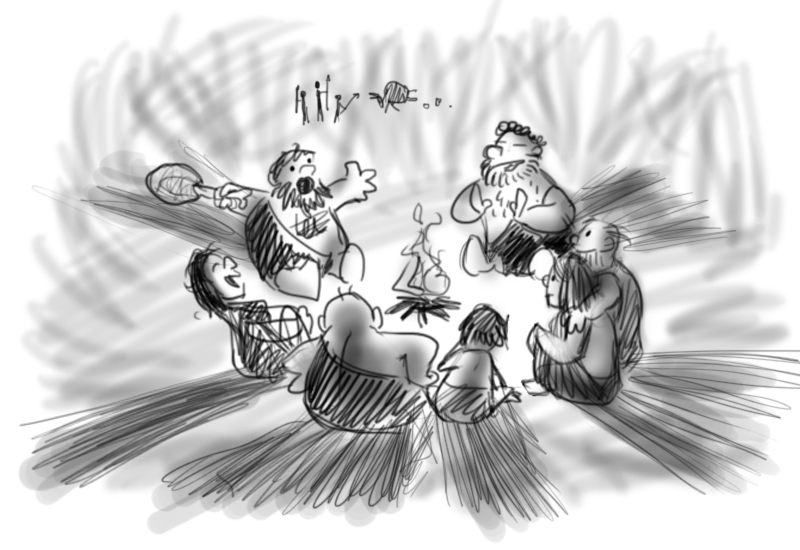
As Harari notes in Nexus, neither chimps nor ants can establish, for instance, empires, religions or trade networks. Humans can. It’s because we developed the abilities and aptitude to tell, believe and be moved by stories. We’ve been doing it ever since we crawled out of caves and swapped tales by the fire.
It’s stories that connect us
To cooperate in large numbers, we don’t need to know each other personally. We just need to know the same story.
“A story can serve like a central connector, with an unlimited number of outlets into which an unlimited number of people can plug,” Harari writes.
Over history, they’ve been stories about everything from ideologies to nationalism, and currencies to corporations. Harari states that stories brought us together, books spread our ideas and mythologies, and the internet promised infinite knowledge. So what comes next?
Nexus is subtitled A Brief History of Information Networks from the Stone Age to AI. If we’re going to thrive and survive, we need to look at what got us here. Which is why Nexus starts with such a central question: What does information do?
Will truth win out?
By collecting, managing and analyzing much more information than any one individual can, big networks allow us to achieve a better understanding of any topic imaginable.
That’s the typical framing, says Harari. Ignorance takes us nowhere. Information leads to truth. And truth leads to power and wisdom (and the power to use that wisdom well).
In this understanding, he writes, “The antidote to most problems we encounter in gathering and processing information is gathering and processing even more information.”
But Harari suggests there’s a flaw in this model.
It’s not that we can make faulty analyses based on partial information. (Though we can.) Or that malicious actors, motivated by greed or hate, can outright “hide facts or aim to deceive”. (Though they do.)
Those things happen, but aren’t the weaknesses. This is – the thinking that if only we toss more facts at people who are “ill informed”, the “truth” will win out in the free market of information.
Such a conclusion is a critical misunderstanding about how big information networks operate, argues Harari.
A “naïve” view of information
It’s what he calls the “naive view of information”, one that has been used to justify the pursuit of more and more powerful information technology and systems.
The logic goes that information is essentially a good thing, so the more we have of it, the better.
Yet that’s not always the case. Harari notes many populist movements over time discount the idea of objective “facts” and “truth”, and weaponize information for their own purposes.
Sound familiar?
In our current climate, he says we’ve seen a backlash against traditional institutions and those who comprise them (government officials, scientists, journalists, etc.) that claim to gather information and discover truth.
Moreover, Harari reminds that some of history’s most powerful networks have been completely delusional yet immensely powerful, spreading fictions, bad information, disinformation and fantasies.
In contemplating the nature of information, he says we can dwell on its content and veracity. But we don’t always ask an essential question: how well does it connect people?
A story doesn’t need to be true to succeed in uniting people; it just has to be persuasive enough.
Written in the stars
While Harari agrees that truth is an accurate representation of reality, he suggests that more information is not an attempt to represent that reality.
Take our night sky, which provide us with abundant information.
“According to the naive view,” Harari writes, “astronomers derive ‘real information’ from the stars, while the information that astrologers imagine to read in constellations is either misinformation or disinformation.”
He continues, “If only people were given more information about the universe, surely they would abandon astrology altogether. But that fact is that for thousands of years astrology has had a huge impact on history, and today millions of people still check their star signs before making the most important decisions of their lives.”
Harari uses the example to underscore this point: “What information does is create new realities by tying together disparate things – whether couples or empires.”
It may seem paradoxical, but he says information doesn’t necessarily inform us about things.
“Rather, it puts things in formation. Horoscopes put lovers in astrological formations, propaganda broadcasts put voters in political formations, and marching songs put soldiers in military formations.”
We’re in the midst of creating new and infinitely more powerful information networks, with AI and beyond. As we do, here’s a caution.
“If no additional steps are taken to tilt the balance in favour of truth,” warns Harari, “an increase in the amount and speed of information is likely to swamp the relatively rare and expensive truthful accounts by much more common and cheap types of information.”
We’re compelled to understand where these networks (and us) can go awry. For our future isn’t written in the stars. We’re the ones authoring it.
Stuart Foxman is a Toronto-based freelance writer, who helps clients’ products, services, ideas and organizations to come alive. Connect with me here on LinkedIn, check me out at foxmancommunications.com or follow me on X (formerly Twitter) @StuartFoxman where I share these blogs too. More original posts coming regularly about communications, information, motivation, writing, branding, creativity, media, marketing, persuasion, messages, learning, etc.
March 12, 2025